
We'll Never Be Free
And other comforting tales about consumerism

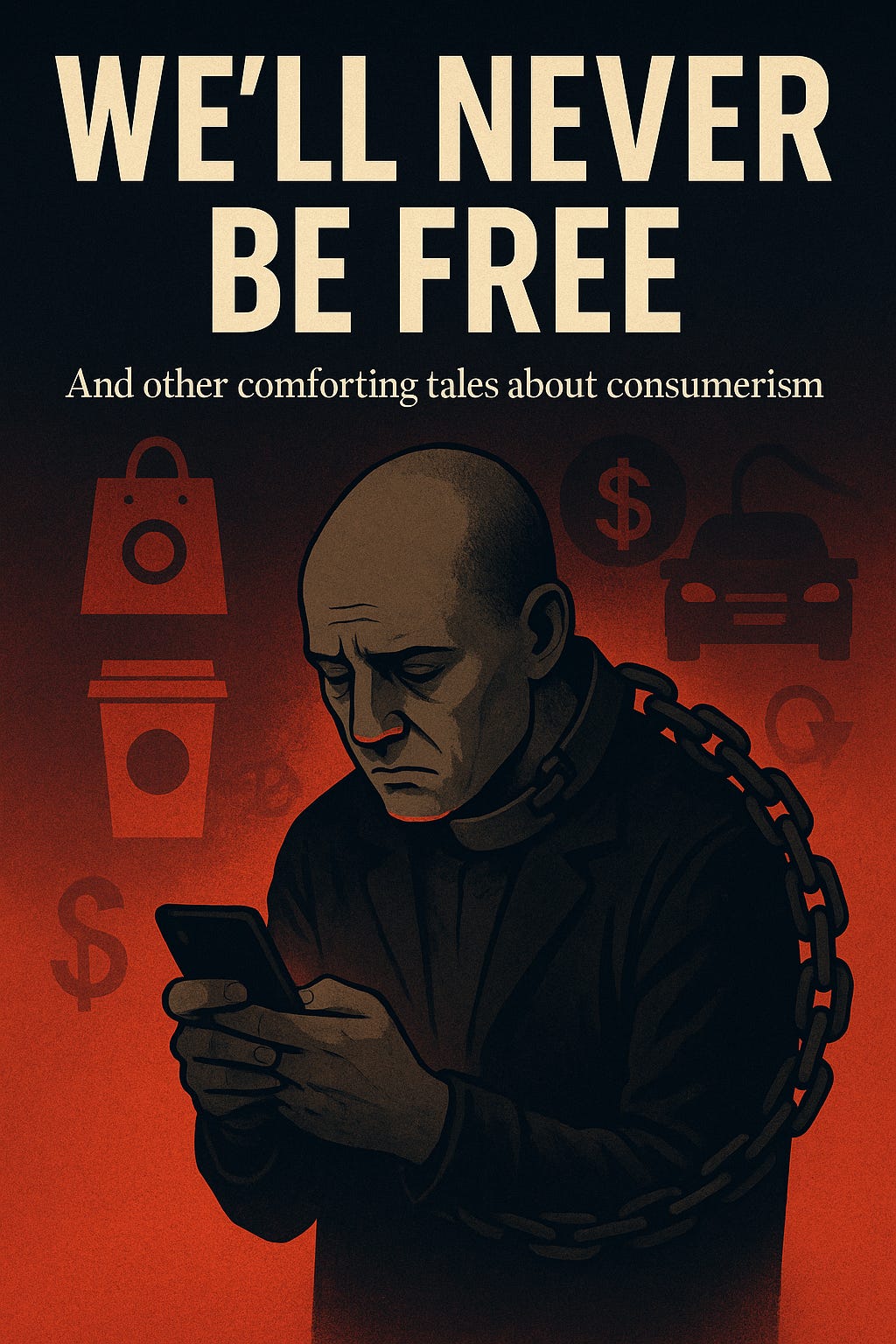
You wake up and reach for your phone. Not because you need to check the time but because your brain needs the dopamine hit from scrolling through notifications.
The phone cost you $1,200 because your friends made you feel like shit about having an Android with green bubbles in the group chat. So you bought the latest iPhone even though your old phone worked fine.
You scroll through news designed by teams of PhDs to keep you scrolling. You check Instagram and feel inadequate looking at other people’s lives. You drive a car you’re still paying for - 72 months at 6% interest - to a job where you help sell things to people who don’t need them so you can afford to buy things you don’t need.
You stop for coffee. Seven dollars for something you could make at home for forty cents. But the cup has a logo and the barista knows your name and it makes you feel like you’re participating in something.
You’re trapped. You’ve always been trapped.
What IS This?
Consumerism isn’t just capitalism. It’s what happens when any society develops surplus production, mass communication, and human status anxiety.
Ancient Rome had luxury goods and conspicuous consumption. Senators competed over who had the most elaborate villas and imported wines. Medieval Europe needed sumptuary laws - actual legislation dictating who could wear what fabrics and colors - because people kept consuming beyond their social class and it threatened the hierarchy.
The Soviet Union was nominally anti-capitalist and it was still deeply consumerist. People wanted jeans and refrigerators and Western cigarettes. They just had to get them through different channels. Black markets thrived because changing the economic system didn’t change human desire.
Modern Scandinavian countries have robust social safety nets and progressive taxation. They’re still intensely consumerist - people work to buy things and chase status through material goods. The system is more humane, but it’s the same fundamental loop.
China is nominally communist and might be the most consumerist society on earth right now.
Every civilization that’s developed past subsistence level ends up here. Maybe consumerism isn’t a bug in the system. Maybe it’s just what humans do when we’re not actively starving.
That’s an uncomfortable realization. There might not be a way to have advanced human society without this trap.
False Escapes
You know the system is fucked. Everyone knows the system is fucked. So we look for ways out.
The first escape route most people find is conscious consumerism. Buy organic. Support sustainable brands. Choose products that align with your values. Feel good about what you’re putting in your cart.
This is the most insidious trap because it gives you the illusion of escape while deepening your participation.
You pay triple for organic produce that was still picked by exploited workers and shipped thousands of miles. You buy bamboo toothbrushes to feel virtuous while Amazon delivers them in plastic packaging. You switch to the “clean” laundry sheets because the marketing convinced you that regular detergent is poison, but you’re still buying cleaning products on the same schedule.
The whole wellness industry runs on this. Expensive supplements to optimize your health. Yoga mats made from “sustainable” materials. Meditation apps you pay monthly for. Even minimalism became a brand you can buy books about.
And here’s the really fucked up part: you need to make more money to afford all this consciousness.
Organic groceries cost fifteen to thirty percent more than conventional. Sustainable clothing costs double or triple. The cruelty-free everything adds up fast. So now you need to earn more to maintain your ethical consumption habits.
How do you earn more? You work longer hours. You sell more products to more people. You optimize your business to extract more value from customers. You launch another product line.
The conscious consumer becomes the most productive participant in the system they’re trying to escape.
You’re grinding harder than ever because sustainable living is expensive as fuck. The yoga instructor teaches twenty classes a week to afford the organic lifestyle she’s selling. The wellness coach launches another course about finding balance while working sixty hours a week to market it.
We’re all running faster on the same hamster wheel. It just has better branding now.
The system loves this. Premium customers are the best customers. They buy more expensive products more frequently and they feel virtuous doing it. You’re not escaping consumerism - you’re upgrading your subscription to premium consumerism.
The cage just got bigger and prettier.
Another Fantasy
Maybe conscious consumerism is bullshit. So what’s the real escape?
When most people (including me) think about escaping the system, the mental pathway leads to the same place: having enough money to stop worrying about money.
Financial independence. Passive income. Fuck-you money. The dream is making enough that you can stop the grind and just... live.
But what does that dream actually look like?
A nicer house. A better car. Fancy dinners whenever you want them. Travel to exotic destinations. The freedom to buy the fancy coffee without checking your bank account. Organic everything without budgeting for it.
It’s still just consumption. Premium, guilt-free, abundant consumption.
We’re not dreaming of escape from the system. We’re dreaming of ascending to the top of it.
The financial independence movement is just another product being sold. Books about how to retire early. Courses on passive income. Investment strategies and real estate seminars. The people making money teaching you how to escape the rat race are... still in the rat race. They’re just selling a different product.
What Real Escape Actually Looks Like
You want to know what actual escape from consumerism looks like?
No smartphone. No electricity bill. No mortgage or rent. No car payment. No health insurance. No streaming services. No Amazon Prime. You grow your own food or hunt it. You make your own shelter. You’re completely removed from the monetary economy.
Some people actually do this. Off-grid homesteaders. Intentional communities. People who genuinely walked away from everything.
But that’s not what anyone means when they talk about “escaping the rat race.” Because that version of escape requires giving up almost everything we think makes life worth living. Modern medicine. Climate control. Reliable food supply. Connection to other humans beyond your immediate community.
To most people, that doesn’t look like liberation. It looks like deprivation. It looks like insanity.
What about the homeless? Are they free from the system?
No. They’re trapped in a different, harsher version of it. They’re still dependent on it for food, shelter, survival - they just have zero leverage within it. That’s not escape. That’s powerlessness.
So we’re left with an uncomfortable truth: actual escape is either impossible or indistinguishable from poverty. And poverty isn’t freedom —it’s just a worse version of the same trap.
Can We Change The System Itself?
Maybe the problem isn’t how we participate, but the system itself. Different economic structures could fix this, right?
No. They don’t.
I already mentioned the Soviet Union—still consumerist, just with worse products and longer lines. The desire to consume didn’t disappear when they changed the economic system.
Scandinavian social democracies have strong safety nets, universal healthcare, generous parental leave, shorter work weeks. These things genuinely matter. Life is measurably better in Denmark than in the United States for most people.
But Danes still work to buy things. They still chase status through material goods. They still scroll Instagram and want what they see. The system is more humane, but it’s still the same fundamental loop: work, earn, buy, repeat.
Every alternative we’ve tried still ends up here. Different packaging, same core.
Maybe the trap isn’t capitalism specifically. Maybe it’s civilization at scale. Maybe it’s just human psychology meeting surplus production meeting mass media.
That’s a bleak fucking realization.
Making The Cage More Comfortable
So if we can’t escape and we can’t fundamentally change the system, what the fuck do we do?
We can make it less brutal.
Better labor laws that actually get enforced. Living wages so people aren’t working three jobs to afford rent. Shorter work weeks so people have actual lives outside of work. Universal healthcare so medical bankruptcy isn’t a thing. Strong environmental regulations with teeth. Wealth redistribution through progressive taxation so billionaires can’t exist while people work themselves to death for scraps.
These things would matter. They’d make real differences in real lives.
But they’re not escape. They’re harm reduction.
The Scandinavian model demonstrates this. Strong unions, generous benefits, actual work-life balance, free education and healthcare. People there aren’t free from consumerism, but the floor is higher and the exploitation is less extreme. You’re not one medical emergency away from financial ruin. You’re not sacrificing your entire youth to student loan debt.
Is that the best we can do? Make the cage more comfortable?
Maybe. And honestly, that’s not nothing.
The difference between working sixty hours a week with no healthcare and working thirty-five hours a week with actual security - that’s a genuine quality of life difference. That matters to the people living it.
We’re not liberating anyone. We’re negotiating better terms for the imprisoned.
That’s still worth fighting for.
Sit With This
There’s no clean resolution here. No three-step plan to free yourself from the matrix. No life hack that lets you transcend the system while still enjoying the benefits of living in it.
You’re trapped. I’m trapped. We’re all goddamn trapped.
Maybe we’ve always been trapped. Maybe every human society beyond subsistence level inevitably creates some version of this. Maybe advanced civilization and consumerism are inseparable.
That’s uncomfortable to accept. We want to believe there’s a way out. A secret door. A better system just beyond our current understanding.
But wanting something doesn’t make it true.
The most honest thing I can say is this: we’re stuck in a system that extracts value from us, sells us solutions to problems it created, and offers escape routes that lead right back to the same trap. The only realistic goal isn’t escape. It’s making the conditions less brutal for everyone stuck in here with us.
That’s not inspiring. That’s not a rallying cry. That’s not going to get turned into motivational Instagram posts.
But it’s honest.
And maybe honesty about the trap is the first step toward making it more bearable.
Not freedom, just better terms.
Not liberation, just harm reduction.
That will have to be good enough for now.
👍🏻👍🏻👍🏻
My close friends and I discuss this concept and how to not be as much of a “slave” to it, but utilize in moderation.
But in the end, it’s what drives a lot of things. Just buy less shit you don’t need.